 |
 |
 |
 |
 |
|
 |
|
 |
|
 |
|
 |
|
 |
|
 |
 |
Comparing CRMs: Navigating the Complex Landscape of Customer Relationship Management SolutionsIn the ever-evolving world of business technology, selecting the right Customer Relationship Management (CRM) system is a decision that carries significant weight, influencing not only how companies interact with their customers but also how they drive growth and streamline operations. The landscape of CRM solutions is vast and varied, with each platform offering its own unique blend of features, capabilities, and potential pitfalls. Thus, a comprehensive understanding of these systems is crucial for making an informed choice that aligns with specific business needs and goals. To begin with, functionality is a paramount factor to consider when comparing CRM systems. At their core, CRMs are designed to enhance customer interactions and foster relationships, yet the means by which they achieve this can differ greatly from one platform to another. For example, some CRMs focus heavily on automation and integration, allowing businesses to streamline workflows and seamlessly connect with other tools in their tech stack. Others might emphasize analytics and reporting, providing deep insights into customer behaviors and sales trends. A thorough assessment of which functionalities are most critical to your business can narrow down the options significantly. Another critical consideration is scalability. As businesses grow, their needs evolve, and a CRM that fits perfectly today might not suffice in a few years. Therefore, opting for a solution that can scale with the company is prudent. This means evaluating whether the CRM can handle increased data loads, additional users, and expanding customer bases without compromising on performance or usability. The ability to customize and extend the CRM's capabilities, either through native features or third-party integrations, can also play a pivotal role in ensuring long-term viability. Moreover, user experience cannot be overlooked. A CRM system is only as effective as its adoption rate, which hinges largely on how intuitive and user-friendly it is. Platforms that offer a clean interface and straightforward navigation tend to encourage user engagement, reducing the learning curve and minimizing resistance to change. Training resources, customer support, and community forums are additional elements that enhance user experience, making the transition to a new CRM smoother and more efficient. Finally, cost is an inevitable factor in the decision-making process. While it's tempting to gravitate towards lower-priced options, it's essential to weigh the cost against the value delivered. Subscription models, licensing fees, and the potential need for ongoing maintenance or upgrades should all be considered. Sometimes, a higher upfront investment in a robust CRM can yield greater returns in the long run through increased productivity and enhanced customer satisfaction. In conclusion, comparing CRMs is not merely about finding the most feature-rich platform but about identifying the solution that best fits your business's unique requirements and future aspirations. By carefully evaluating functionality, scalability, user experience, and cost, companies can make a strategic choice that supports their customer relationship management efforts and propels their business forward. https://compare-crm.com/
With an easy to use platform and mobile app, if you're looking for SMS and MMS message marketing, Skipio is for you. However, you'll have to find different ... https://www.bigin.com/compare-crm/
Bigin by Zoho CRM is a simple yet powerful tool for any small or micro-sized business. Read on to find out what makes Bigin stand above the rest. https://www.zoho.com/crm/compare/
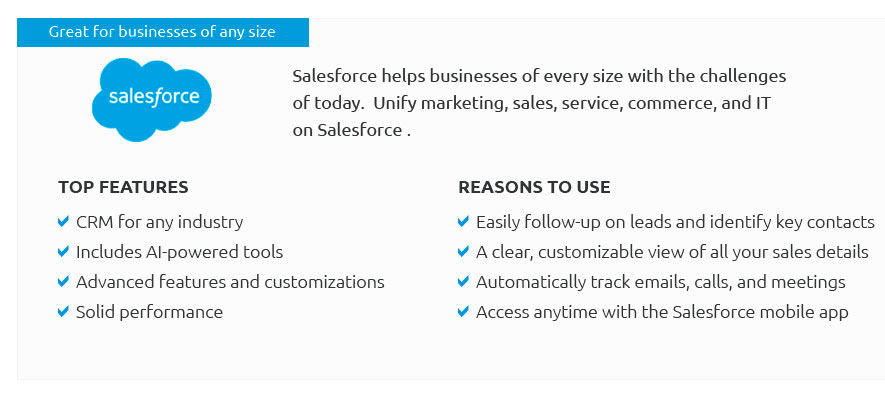
Compare the top CRMs. Zoho CRM vs Salesforce. Salesforce offers a wide range of features and a highly extensible platform to businesses of all sizes.
|
